Arduino simple serial echo

Part of my process of going from a large and complicated A, to a large and complicated B is to do small things along the way that gradually inch me closer to what I want to do.

What I really wanted was this example of an arduino script from which I could test and get confidence on my next step in the process.

without too much explanation, this short arduino code tells your peripheral device to receive a string on the serial communication port and send it back out to the same serial communication port.


/* Arduino serial echo

The circuit:
Any serial device attached to Serial port
Serial monitor open on Serial port:

This example code is in the public domain.*/

void setup() {
// initialize serial port:
Serial.begin(115200);
}

void loop() {
// read from port, send to port:
if (Serial.available()) {
char inStr = Serial.read();
// delay(100) //optional delay of 1ms
Serial.write(inStr);
}
}


Geez.  That wasn’t so hard was it?  Now hopefully if anyone searches google for an arduino serial echo they will get here and be able to make handy use of this script along the way to bigger things.


Meta: This took 10mins to write

Edit: oh hey look here it is https://www.arduino.cc/en/Serial/Available same as my script only I didn’t know the command Available prior to hacking it into a script

Posted in electronics | Tagged , , , , , , | Leave a comment

correlations, correlation – What came before

I went to a funeral once for someone I had recently met.  it was unfortunate and I barely knew him.  At the ceremony his father got up and said:

to the young people in the room, my son was a great kid he was happy and healthy and then one day he tried drugs, and he was never the same.  He got very sad and turned very dark and then one day he took his own life.

Don’t take drugs.

Not bad advice, stay away from X, because it caused my son’s death.

Today I was reconsidering this advice.  In the context of drugs.  What we know generally of people who are living on the streets and taking drugs, they often have mental health troubles, but along with that they will often take the drug that is the street version of the prescription drug designed to help the mental health condition that they have.  Almost in the self-prescription form.  As far as we know – they do this because it feels better.  Treating the underlying mental health condition is a big and important effect of drug-taking.  (Some people just take drugs.  Let’s not talk about them right now)

In light of this concept of self-treating drug treatment I have to consider, which came first.  Was it the drugs or was it the condition that caused him to reach out to drugs.  I can’t credit a father to know everything about his son, there might have been more drugs, there might have been more conditions and more stress.  I don’t want to speak of his memory in vain.  Maybe there was more going on.

I have always asked myself – can I do more?  Could I have done more?  Could I have known.  (not in the beat-myself-up eternally way, but in the can-I-be-ready-for-next-time), in order to be prepared, I ask the question – What came before?

(a post for another day) I ask the same question for any breaking-down argument.  What came before?

But what’s the moral of the story?  People die.  That guy is still gone.  I don’t know what to do.  But I have one idea.  It takes a 10 minute commitment:

  1. Go to your list of facebook friends
  2. Look for the people who you think of as most unhappy, most miserable, most angry, most misunderstood, most lost, most alone…
  3. Send them a message.  Talk about it.

No one has to be alone.


Meta: this took 30mins to write.

Posted in life maintenance | Tagged , , , , , , | Leave a comment

Vegetarian moussaka

Cultivated a moussaka recipe.

Moussaka is a mostly eggplant based recipe which involves layers of flavours of various vegetables.  When you take a mouthful through several layers you want to experience several flavours at once.  Which means that you want the several vegetable parts cooked in flavourful ways so that they still hold their original form, but also can be eaten with ease.  This dish commonly is made with a meat filling but I chose to make a vegetarian version.

I happen to know a few of the flavours and vegetables I like already so I picked those as the layers (after looking at a few recipes online).

Ingredients:

  • 1 jar of tomato-pasta sauce
  • 1 large eggplant
  • 1 zucchini
  • 1 tennis-ball sized brown onion
  • 700g of sliced mushrooms
  • 250g potato
  • garlic
  • olive oil
  • truffle oil
  • pepper + salt
  • butter
  • cornflour
  • 750ml milk
  • shredded cheese
  • breadcrumbs
  • lazagne sheets

Prep:

each of the onion, zucchini, eggplant, potato and mushrooms need cooking.  How you do that is up to you.  It’s especially exciting if each of them has a unique flavour.

Once you have approximately the flavour, each ingredient gets added as a layer to the final dish.

Here is how I did my layers:

  1. Pasta sauce on the bottom, followed by a lazagne sheet and some pasta sauce on top.  The sauce will soak into  the sheets and make a soft base for the dish.
  2. Onions
    fried in olive oil (simple flavour, good base)
  3. Eggplant
    slice them thin (1/4cm or thinner), lay them on an oven tray with some olive oil and truffle oil, bake for around 15mins @ 180c to lightly cook through.
  4. Zuccini
    Similar to the eggplant, some herbs on top, baked with light drizzle of olive oil.  Add pepper as needed.
  5. Pasta sauce and Lazagne sheet again
  6. Mushroom
    Fried, with garlic. (they will shrink) the earlier you add the garlic the weaker it will be.  If you want powerful garlic, add it just as you finish frying.
  7. Potatoes
    I sliced mine as thin as I could then microwaved them to cook them.  This is very lazy.  but it works.  A better way to cook them would be baked or boiled with butter/cream or any other flavour that you like.
  8. white sauce
    1. melt 2 tablespoons of butter in a pot
    2. Take it off the heat, and add two heaped tablespoons of cornflour and mix till the cornflour is a paste with the butter.
    3. Add 1-2 cups of milk (optional: cream) and stir to dissolve the cornflour
    4. Put back on the heat for 10mins and stir so that the sauce thickens.
  9. Cheese
    For delicious meltyness
  10. breadcrumbs
    For extra crunch.

Bake for around 30mins at 180c or until the cheese is crispy.  All of the ingredients are pre-cooked (except for the lazagne sheets) so this step is mostly to bring the flavours together, melt the cheese and get the lazagne soft.

Serves 10, more or less depending on the size of your vegetables.

Also is delicious.


Meta: takes 45mins to prepare + 15-30mins in the oven to melt the cheese,

Writing this down took 15mins.  After some feedback, rewriting this took 20 minutes.

Posted in Hobbies | Tagged , , , , , | Leave a comment

One model of understanding independent differences in sensory perception

This week my friend Anna said to me; “I just discovered my typical mind fallacy around visualisation is wrong”. Naturally I was perplexed and confused. She said;

“When I was in second grade the teacher had the class do an exercise in visualisation. The students sat in a circle and the teacher instructed us to picture an ice cream cone with our favourite ice cream. I thought about my favourite type of cone and my favourite flavor, but the teacher emphasised “picture this in your head, see the ice cream.” I tried this, and nothing happened. I couldn’t see anything in my head, let alone an ice cream. I concluded, in my childish vanity, that no one could see things in their head, “visualising” must just be strong figurative language for “pretending,” and the exercise was just boring.”

Typical mind fallacy

“everyone thinks like me” (Or A-typical mind fallacy – “no one thinks like me”). My good friend had discovered (a long time ago) that she had no visualisation function. But only recently made sense of it (approximately 15-20 years later). Anna came to me upset, “I am missing out on a function of the brain; limited in my experiences”. Yes; true. She was. And we talked about it and tried to measure and understand that loss in better terms. The next day Anna was back but resolved to feeling better about it. Of course realising the value of individual differences in humans, and accepting that whatever she was missing; she was compensating for it by being an ordinary functional human (give or take a few things here and there), and perhaps there were some advantages.

Together we set off down the road of evaluating the concept of the visualisation sense. So bearing in mind; that we started with “visualise an ice cream”… Here is what we covered.

Close your eyes for a moment, (after reading this paragraph), you can see the “blackness’ but you can also see the white sparkles/splotches and some red stuff (maybe beige), as well as the echo-y shadows of what you last looked at, probably your white computer screen. They echo and bounce around your vision. That’s pretty easy. Now close your eyes and picture an ice cream cone. The visualisation-imagination space is not in my visual field, but what I do have is a canvas somewhere on which I draw that ice cream; and anything else I visualise. It’s definitely in a different place. (We will come back to “where” it is later)

So either you have this “notepad“; “canvas” in your head for the visual perception space or you do not. Well; it’s more like a spectrum of strength of visualisation; where some people will visualise clear and vivid with a photographic memory; and others will have (for lack of better terms) “grey”; “echoes”; Shadows; or foggy visualisation, where drawing that is a really hard thing to do. Anna describes what she can get now in adulthood as a vague kind of bas relief of an image, like an after effect. So it should help you model other people by understanding that variously people can visualise better or worse. (probably not a big deal yet; just wait).

It occurs that there are other canvases; not just for the visual space but for smell and taste as well. So now try to canvas up some smells of lavender or rose, or some soap. You will probably find soap is possible to do; being memorable and regular. The taste of chocolate; kind of appears from all those memories you have; as does cheese; lemon and salt; (but of course someone is screaming at the page about how they don’t understand when I say that chocolate “kind of appears”, because it’s very very vivid to them, and someone else can smell soap but it’s quite far away and grey/cloudy).

It occurs to me now that as a teenage male I never cared about my odour; and that I regularly took feedback from some people about the fact that I should deal with that, (personal lack of noticing aside), and I would wonder why a few people would care a lot; and others would not ever care. I can make sense of these happenings by theorising that these people have a stronger smell canvas/faculty than other people. Which makes a whole lot of reasonable sense.

Interesting yet?  There is more.  This is a big one.

Sound

more specifically music. Having explored the insight of having a canvas for these senses with several people over the past week; And noting that Anna from the story above confidently boasts an over-active music canvas with tunes always going on in her head. For a very long time I decided that I was just not a person who cared about music; and never really knew to ask or try to explain why. Just that it doesn’t matter to me. Now I have a model.

I can canvas music as it happens – in real time; and reproduce to a tune; but I have no canvas for visualising auditory sounds without stimulation. (what inspired the entire write-up here was someone saying how it finally made them understand why they didn’t make sense of other people’s interests in sounds and music) If you ask me to “hear” the C note on my auditory canvas; I literally have no canvas on which to “draw” that note. I can probably hum a C (although I am not sure how), But I can’t play that thing in my head.

Interestingly I asked a very talented pianist. And the response was; “of course I have a musical canvas”, (to my slight disappointment). Of course she mentioned it being a big space; and a trained thing as well. (As a professional concert pianist) She can play fully imagined practice on a not-real piano and hear a whole piece. Which makes for excellent practice when waiting for other things to happen, (waiting rooms, ques, public transport…).

Anna is not a musician, and says her head-music is not always pleasant but simply satisfactory to her. Sometimes songs she has heard, but mostly noises her mind produces. And words, always words. She speaks quickly and fluently, because her thoughts occur to her in words fully formed.

I don’t care very much about music because I don’t “see” (imagine) it. Songs do get stuck in my head but they are more like echoes of songs I have just heard, not ones I can canvas myself.

Now to my favourite sense. My sense of touch. My biggest canvas is my touch canvas. “feel the weight on your shoulders?”, I can feel that. “Wind through your hair?”, yes. The itch; yes, The scrape on your skin, The rough wall, the sand between your toes. All of that.

It occurs to me that this explains a lot of details of my life that never really came together. When I was little I used to touch a lot of things, my parents were notorious for shouting my name just as I reached to grab things. I was known as a “bull in a china shop” because I would touch everything and move everything and feel everything and get into all kinds of trouble with my touch. I once found myself walking along next to a building while swiping my hand along the building – I was with a friend who was trying out drugs (weed), She put her hands on the wall and remarked how this would be interesting to touch while high. At the time I probably said something like; “right okay”. And now I understand just what everyone else is missing out on.

I spend most days wearing as few clothes as possible, (while being normal and modest), I still pick up odd objects around. There is a branch of Autism where the people are super-sensitive to touch and any touch upsets or distracts them; a solution is to wear tight-fitting clothing to dull the senses. I completely understand that and what it means to have a noisy-touch canvas.

All I can say to someone is that you have no idea what you are missing out on; and before this week – neither did I. But from today I can better understand myself and the people around me.

There is something to be said on this topic for various methods of thinking; some people “think in words”, and some people don’t think in words, they think in pictures or concepts. I can’t cover that in this post; but keep that in mind as well for “the natural language of my brain”

One more exercise (try to play along – it pays off). Can you imagine 3 lines, connected; an equilateral triangle on a 2D plane. Rotate that around; good (some people will already be unable to do this). Now draw three more of these. Easy for some. Now I want you to line them up so that the three triangles are around the first one. Now fold the shape into a 3D shape.

How many corners?
How many edges?
How many faces?

Okay good. Now I want you to draw a 2D square. Simple; Now add another 4 triangles. Then; like before surround the square with the triangles and fold it into a pyramid. Again;

How many edges?
How many corners?
How many faces?

Now I want you to take the previous triangle shape; and attach it to one of the triangles of the square-pyramid shape. Got it?

Now how many corners?
How many edges?
How many faces?

That was easy right? Maybe not that last step. So it turns out I am not a super visualiser. I know this because those people who are a super visualisers will find that when they place the triangular pyramid on to the square pyramid; The side faces of the triangle pyramid merge into a rhombus with the square pyramid; effectively making 1 face out of 2 triangle faces; and removing an edge (and doing that twice over for two sides of the shape). Those who understand will be going “duh” and those who don’t understand will be going “huh?”, what happened?

Pretty cool right?

Don’t believe me? Don’t worry – there is a good explanation for those who don’t see it right away – at this link http://wordplay.blogs.nytimes.com/2013/09/23/pyramid-2/?_r=1

From a super-visualiser:

“I would say, for me, visualisation is less like having a mental playground, and more like having an entire other pair of eyes. And there’s this empty darkness into which I can insert almost anything. If it gets too detailed, I might have to stop and close my outer eyes, or I might have to stop moving so I don’t walk into anything. That makes it sound like a playground, but there’s much more to it than that.

Imagine that you see someone buying something in a shop. They pay cash, and the red of the twenty catches your eye. It’s pretty, and it’s vivid, and it makes you happy. And if you imagine a camera zooming out, you see red moving from customers to clerks at all the registers. Not everyone is paying with twenties, but commerce is red, now. It’s like the air flashes and lights up like fireworks, every time somebody buys something.

And if you keep zooming out, you can see red blurs all over the town, all over the map. So if you read about international trade, it’s almost like the paper comes to life, and some parts of it are highlighted red. And if you do that for long enough, it becomes a habit, and something really weird starts to happen.

When someone tells you about their car, there’s a little red flash just out the corner of your eye, and you know they probably didn’t pay full price, because there’s a movie you can watch, and in the time they got the car, they didn’t have a job and they were stressed, so there’s not as much red in that part of the movie, so there has to be some way they got the car without losing even more red. But it’s not just colors, and it’s definitely not just money.

Happiness might be shimmering motion. Connection with friends might be almost a blurring together at the center. And all these amazing visual metaphors that you usually only see in an art gallery are almost literally there in the world, if you look with the other pair of eyes. So sometimes things really do sort of jump out at you, and nobody else noticed them. But it has to start with one thing. One meaning, one visual metaphor.”

Synaesthesia

Way up top I mentioned the “where” of the visualisation space. It’s not really in the eye, a good name for it might be “the mind’s eye“. My personal visualisation canvas is located back up left tilted downwards and facing forwards.

Synaesthesia is a lot of possible effects. The most well known one is where people associate a colour with a letter, when they think of the letter they have a sense of a colour that goes with the letter. Some letter’s don’t have colours, sometimes numbers have colours.

There are other branches of Synaesthesia. Locating things in the physical space. Days of the week can be laid out in a row in front of you; numbers can be located somewhere. Some can be heavier than others. Sounds can have weights; Smells can have colours; Musical notes can have a taste. Words can feel rough or smooth.

Synaesthesia is a class of cross-classification that is done when the brain interprets a stimulus, where (we think) it can be caused by crossed sensory wiring in the brain; It’s pretty fun. Turns out most people have some kind of Synaesthesia. Usually to do with weights of numbers, or days being in a row. Sometimes Tuesdays are lower than the other days. Who knows. If you pay attention to how sometimes things have an alternative sensory perception, chances are that’s a bit of the natural Synaesthete coming out.

So what now?

Synaesthesia is supposed to make you smarter. Crossing brain faculty help you remember things better; if you can think of numbers in terms of how heavy they are you could probably train your system 1 to do simple arithmetic by “knowing” how heavy the answer is. If it doesn’t come naturally to you – these are no longer low-hanging fruit implementations of these ideas.

What is a low-hanging fruit; Consider all your “canvases” of thinking; Work out which ones you care more about; and which ones don’t matter. (when I write it I will insert a link to superpowers and kryptonites: use your strong senses to your advantage; and make sure you avoid using your weaker senses) (or go on a bender to rebuild your map; influence your territory and train your sensory canvases. Or don’t because that wouldn’t be a low hanging fruit).

Keep this model around

It can be used for both good and evil. But get the model out there. Talk to people about it. Ask your friends and family if they are able to visualise. Ask about all the senses. Imagine if suddenly you discovered that someone you know; can’t “smell” things in their imagination. Or doesn’t know what you mean by, “feel this” (you have no idea what you are missing out on the touch spectrum in my little bubble).

You are going to have good senses and bad ones. That’s okay! The more you know; the more you can use it to your advantage!


Meta: Post write up time 1 hour; plus a week of my social life being dominated by the same conversation over and over with different people where I excitedly explain the most exciting thing of this week. plus 1hr*4, plus 3 people editing and reviewing, plus a rationality dojo where I presented this topic.

Meta2: I waited 3 weeks for other people to review this. There were no substantial changes and I should have not waited so long. in future I won’t wait that long.

Originally posted here:  http://lesswrong.com/lw/ms9/one_model_of_understanding_independent/

Posted in models of thinking, self-improvement | Tagged , , , , , , , , , , , | Leave a comment

Should you change where you live? (a worked “how to solve a question”)

It’s not a hard question, but it potentially has a lot of moving parts.

This post is going to be two in one.  The first is whether you should move geography, the second is how I go through a problem.  In red.

First up – brainstorm ideas:

Meta-level

  • Make a list of relevant factors of staying or going (then google it to check for any I missed)
  • Decision making strategies

Object level

  • Why did this come up?
  • Make a list of things you wish were different with how you live now
  • Make a list of features of your current geography
  • Make a list of features that you know of in other geographies that you would like to obtain.

relevant factors

  • Family
  • Friends
  • Relationships
  • Population density
  • Population diversity breakdown
  • Local safety (bad neighbourhoods)
  • Religion
  • Politics, country-scale political climate
  • Government structure, public welfare
  • public transport
  • cost of living
  • quality of food, variation of food, culture of food.
  • exchange rate
  • Normal temperature/weather/climate (rain, cloud, sun, heat, cold, wind)
  • Extreme weather risk.  (i.e. cyclones, earthquakes, bushfires)
  • Work (and commute)
  • Salary
  • Pollution (Light, Air or noise pollution)
  • Residential or natural environment, parks, trees, tall buildings…
  • Ocean (if you swim, or like beach culture)
  • Landmarks
  • native plants, animals, diseases.
  • culture, art.
  • difficulty in moving
  • opportunity/plans
  • language barrier
  • public amenities
  • Education
  • Dwelling -> upsize, downsize, sidegrade…
  • Sleep – are you getting enough of it
  • postage costs

Why did this come up?

Usually you are thinking of a seeding factor; a reason why you are moving.  It will help to keep it in mind when planning other things.  Is there something wrong or pushing you out, is the current location stagnant, is something pulling you?  Write that down.    Keep it in mind.  Considering the context of the event may help you make a more informed choice, it’s also why it’s often hard to ask for advice without being more specific about what seems to be the difficulty.

Factors

When you move you will be exchanging your current set of these factors for a new and different set of these factors.  Sometimes you might move with your family, sometimes you might be moving across town and still have the same public transport network but just pay cheaper rent.

Your job; should you choose to accept it: work out which ones are getting better, which are getting worse, and which are staying the same.  Some of them will do both.

Example: you live in a small town with a few friends. you are moving to a big city where you know nobody but you expect to make many more friends quickly.  friends are getting both worse and better at the same time.

How?

There should be some instruction set to make it easier to actually come to an answer.  Not everyone could have automatically generated this list, and not everyone will know what to do with it now.  So what to do with the information is listed here.

  1. Take the list above – best of copied to a spreadsheet, make two copies of the list, for each point; write a few words about what you have now in your current location.
  2. If certain points seem irrelevant to you then don’t worry.  Cross them out.
    E.g. If the weather doesn’t bother you much then you can skip it.
  3. For each point, out of 10, rate – how much do you care about this factor?  and also out of 10 – How well do you fulfil this need right now.  (this is where it’s necessary to understand which ones you don’t care about)
  4. On the second copy, fill out the details of the place you want to go.  If you don’t yet have a destination; look at the first list and find the things that you care about a lot with a low rating.  to start your search, make a list of places that you expect will have a high rating in those area, or search by that thing (i.e. places of religious significance).Of course there are ways to do this badly.  for example, as above – you live in a small town with a few friends. you are moving to a big city where you know nobody but you expect to make many more friends quickly.  friends are getting both worse and better at the same time.  If on pondering you realise that no place ever will have more friends than the place you are now, because everywhere else is foreign, then that makes it a not-great metric to go on.  However (in this example) you might benefit from considering instead where might have the potential to have good friends, (or crazy ideas like taking your friends with you)
  5. Use your newly laid out knowledge as a guide on where to go and what to look for.

Consider the inverse proposal

Heuristic thinking strategies that might help you.  There are generic ones for problems and then there are questions that suit certain problems very well.  These are relatively generic but I have heard great success in applying them to moving decisions.

This is very generic.  If you are leaving a place for an obvious reason (for example political unrest), it would take a lot to convince you to stay.  This is where the idea of thinking of the inverse proposal comes in.

Example: your work has offered you a promotion.  It’s $20,000 extra.  But you would have to leave your friends and family and work in a city several hours away for at least a year.

Example in reverse:  I am going to offer you a $20,000 pay cut and in exchange you get to live in a town with your friends.

*it can be hard to generate the reverse example from your own perspective.

Some people can easily say, pay “$20k just for my lousy friends, hell no”.  Other people can easily say, “listen boss, $50k and you got a deal.”

Is there an alternative solution

This is a fully generic question to ask.

Before you convince yourself that the factors are out of your hands, consider if you can take it into your own hands.  If you don’t at least ask, you will genuinely never know if it could have gone differently.  Can you take your friends with?  Can you take the pay rise but not move for work?  Can you still have a nice lake even if you don’t have an ocean?  Who knows.  At least consider it.

How can you make it easier for yourself?

This is a fully generic strategy for getting things done.

As with many decisions in life, they are big, they are hard, they are scary.  Are there things you can do to make the decision easier for yourself?


Meta: this took three hours to research and write.

Also posted on Lesswrong.

Posted in life maintenance | Tagged , , , , , , , , , , , , , , , , , , , , , , , , , , , , , , , , , , , , , , , , , , , , , | Leave a comment

What it means to troubleshoot

I went to a tech meetup and someone stood up and said, “does anyone want a project?”.  I have a habit of saying yes too often so naturally I said yes. I would try it.  He gave me an email address.  I fired off a message.

It was a concealed electronics magic trick.  The original proposal was Arduino, with bluetooth.  That’s cool.  I know Arduino enough to hack around.  the project wasn’t hard, I figured I could use standard libraries and hack together a code to make it happen.

Also it has to be small enough to be concealed.

Also he already had a few chips that he gave to me to use.

I was gifted one arduino, two ESP8266 and some extra peripheral logic chips to help them talk.  (~$30 of chips)

I tried to use and ESP alone.  Apparently there is a way to hack them to talk to a PC via an arduino.  So I tried that and gave up.  I bought an FTDI chip on ebay ($6 and two week’s wait).  The right chip, but I spent a solid 5 hours trying to work out why it wasn’t showing up in the software’s list to recognise boards plugged in before I took a break and a day off and talked to a friend and they offered to look.

Bearing in mind that I had changed out every wire I could think of except for the USB cable because I didn’t have one.  Two days later, I was going to go to a makerspace and ask for help when I happenstanced to visit a friend while I had the box of parts in my car.  I grabbed the box and started talking about the project.  About 5 minutes later the problem was the USB mini cable that was a charge-only cable.

I took the project home and started trying to use the FTDI chip for real this time.  I was making progress except that the FTDI wouldn’t talk to the ESP chip.  Some power lights sometimes, but nothing even close to “communication” no matter what I did.  So I took another break.

Consulted a different electronics wiz.  Who said, give up.  Don’t bother with the ESP chip, instead use a NodeMCU which is an FTDI+ESP8266 built in.  Okay.

I bought 4 nodeMCU chips so that I can have two pairs, one for now, and one pair for when I want to do another project and need chips.  ($7*4 = $28 total and one week’s post)


They arrived on a friday and  I didn’t realise so I opened them on Sunday.  It was then I went “hell yea!” and tried to plug them in.  earlier due to all my troubles with the ESP chip alone I was messing around with the code on the bootloaders (the instruction to program the chip from my laptop – apparently in earlier versions of things it needed to be done, and if that was my problem I was willing to try that to fix it).  I tried a few things and looked at the time.  At which point I realised I was 3 hours late to my local hardware meetup.  I was going to stay home and hack when I realised, naa – better go.  bet someone can help me.

Grabbed a box for the project and drove to the meeting.  40mins left in the meeting.

Got to the meeting and sat down on my laptop, figured I would try something.  Uninstall the previous bootloader (that I edited) and reinstall it.  and BAM!

Step 1: Blink. (turn the small builtin LED on and off)  YES!

Step 2: it’s a meetup.  Not 5 minutes into playing around and someone walked past and said “Is that a nodeMCU”.  “yes it is”.  At which point he pulled out two from his bag and said, “teach me how they work”.  Ohshit.jpg

make out like I know what I am doing*.  Point at the chip, information dump everything I know, That’s an ESP8266, that’s the surrounding so you can program it.  That’s the wifi antenna.

(*not actually – in reality I told him I had barely a clue and had just got them.  But I still shared all my knowledge)

Let’s try it.  Putting down my project, we plug his foreign other-brand Node-Mcu equivalent into the micro-usb port, and send it a blink.  Sweet.  I got this.

Turns out a blank board with no sensors or peripherals can’t do more than blink.  Which is okay, blink is my JAM, blink is my skills.  I make it blink in (0.5sec on/1sec off), I swap it.  We can use this board.  (except for, anything practical yet – but at least it turns on)

Meetup swiftly ends because I was late anyway, take my project home.  Plug in and try a generic “wifiAccessPoint” example script.  IT WORKS!  first time.  Sign into the new wifi point on my phone.  go to the test-webpage.  “hello world!”. Aww yeaa!

Plug in a second Node, “wifiClientBasic” example.  to sign into the wifi.  Boards conflict.  Can’t use both at the same computer and see both comm outputs.  That’s okay.  Plug AccessPoint into a USB charger, ClientBasic into my computer.  Client basic boots up, logs into the wifi, and fails to load the test page.

What’s going on at the other end?  No idea.  Need a second computer.  Pull out my old Raspberry Pi. Let’s do this.  Clock says midnight.  Don’t care.  Try plug in Raspberry Pi.  No HDMI port.

Jump on ebay.  VGA->HDMI cable.  ($5 + 1 week’s wait)

Cable arrives.  Test on my laptop.  All G, High Def screen.

Test on Rpi.  Nope.  All of the nothing.  LMGTFY.  you can never go from HDMI->VGA on a pi.  pi doesn’t have the signal output functionality.  A laptop has backwards compatibility built in but not a Pi.

Ebay, tech stores, office stores, Find the right cheap screen.  Next day $150 later.  Beauty.  23inch widescreen.  HDMI port.   Didn’t even forget the HDMI cable + $8.  Let’s do this!

Open the box, plug it in, plug in my Rpi.  Houston we have vision.  Loading setup…  Setup done.

Enter username: …

>no keyboard

Not today!  Left my keyboard at my parent’s house.

Next day.  Swing past parent’s house, collect keyboard.  Come home.  Plug in keyboard.  Plug in PI. Plug in screen.  Loading up.

Enter username: …

Shit.  No idea.  It’s been about a year?  could be anything.  “Eliot”, “ELpi”.  nope.

Brainwave, “raspberry”.  nope.

*facepalm* “pi” (generic username)

Password: …

Shit.

“Raspberry”.

AND WE ARE IN.

Terminal ://> …

Now what?  (thank god for terminal history)  (up arrow a few times)  “startx”

>loads desktop environment.

IN!  >check programs installed -> arduino environment.  YESS winning!

Version 1.0.6.  No.  Not winning.  Obsolete version.

>Rpi has no wifi, *was once thinking cheap and bought the Rpi without an ethernet port*  (this is why I haven’t touched my Pi in years).  Shit.

Wait!  Arduino environment has a serial console!  Plug in the Node anyway!  Rpi nearly crashes (pretty much the least powerful computer you have ever seen).  Get the console open.
> logging in
> connection failed
> logging in
>connection failed
>little lights on the boards are dying like they have no power (they probably don’t)
>switch from a generic usb charger to a name-brand.  Marginally better.

Hrm.  not working. Rpi nearly crashed. might just download the latest environment.
>no wifi

fuckity fuck.
>remembers I bought a wifi usb this one time!
>remembers I couldn’t make it work last time
>start googling

Found lsusb – list devices

>Ralink MT7610
> raspberryPi forums: “I couldn’t make it work”
>”forum page 1 of 16″  it’s going to be a long night.

>”page 4 of 16″
> this driver works.  404page not found
>”page 5 of 16″ This driver if it’s still online.  404.Page Not Found
> “page 6 of 16” This bug is fixed in the latest version of Raspian.  Just Sudo update.
> No internet on Rpi.

Download a new Noobs image via laptop.  1gb, 20mins wait.
>try to work out what to do next while I wait.  30mins later still not quite sure how to do it.
instructions: format the USB.  *Brain* how do I do that.  Internet: no idea.

10mins later.  download KDE partition manager.

Terminal ://> sudo partition manager.

> reformat miniSD card.
> copy NOOBS across (5minutes wait)

>plug in MicroSD to Raspberry.
>power on.
>install raspian
>20mins wait

Raspian turn on…  Username: “pi”

>check wifi config.
>list of local SSID’s

Wifi USB is just *WORKING*  Like Devil magic or some shit.

>Go to open Arduino environment.  *not installed*
jump online.  *feels good to be online*
download the install file for Arduino
> 32bit or 64bit?  Shit.  No fucking idea.  Guess 32?

>downloads .tar zip

> Xarchiver unzip.  10mins.

> terminal ://> downloads/arduino-1.6.9/ Sudo install.sh

command not found

> sudo bash install.sh
*sigh*
>terminal ://> done!

>Run ArduinoIDE
*doesn’t open*

>fuck around with the config of a new system
>restart
>run ArduinoIDE *nothing happens*

>Terminal ://> sudo apt-get install arduino

>building dependency tree… (30mins later, Pi has no processing power)
> downloading
> installing

>Rpi crashes.  Restart.
>install again.  (30mins later – still going).


This is where I am up to.  with a Rpi installing the arduino environment so I can hack on a nodeMCU, I need to get a powered USB hub because the usb charger that powers the PI that powers the Node is not a great trickle-down power supply.  BUT at least I am more prepared and set up for the next project.

Update: sudo apt-get arduino installed version 1.0.5
googled the error I am getting, turns out the 32bit guess was wrong.
>downloading 64bit…


I have given up so many times.  I have started again so many times.  I have hit so many dead-walls of you can’t do anything until this one is fixed.

The summary list:

  • the specifics of getting the bits working on the arduino (not even mentioned here)
  • ESP didn’t work
  • FTDI didn’t work
  • FTDI did work but didn’t talk to ESP
  • NodeMCU didn’t connect to the other node
  • Rpi – no screen
  • Rpi – no keyboard
  • Rpi – no password
  • Rpi – wrong software version
  • Rpi – no arduino environment

And these are just the ones I can remember.  The ones that I had to work out how to solve in the process of doing this project.  Not the ones I worked out how to solve (or troubleshoot) on the last project.


this took 2 hours to write while waiting for progress on compiling code.

Posted in electronics | Tagged , , , , , | Leave a comment

Hacking with a NodeMCU

Today I am hacking on a node MCU.

They look something like this:

I am trying to program them with the Arduino IDE because arduino is stupid easy to use.  Interestingly to bootstrap the NodeMCU to the arduino environment, instead of loading an instruction environment first, then loading code – as you do when you use other environments to program the node.  The arduino environment deletes everything on the node every time you want to write code, and rewrites the whole lot.  This is pretty awesome and probably saved someone from having to write some kind of translation code to make this guy do what that guy says.  As a consequence though; each upload takes around 20-30 seconds.  Even if it’s blink.

(this is blink:)

// the setup function runs once when you press reset or power the board
void setup() {
// initialize digital pin 13 as an output.
pinMode(13, OUTPUT);
}
// the loop function runs over and over again forever
void loop() {
digitalWrite(13, HIGH); // turn the LED on (HIGH is the voltage level)
delay(1000); // wait for a second
digitalWrite(13, LOW); // turn the LED off by making the voltage LOW
delay(1000); // wait for a second
}

It’s pretty simple.  Anyways; I am not sure what will happen for longer programs, I assume they will just take the same amount of time, or be a negligible difference in time for any arbitrary sized program.

The thing that had me stuck today is – as you can see in the picture above, all the pins are numbered D0, D1, D2, but also some of them are reused for other functions.  Which means if I want to use them to turn on an LED I block whatever else was planning to use that GPIO.  When I got these chips I felt like they had more pins.  With more hacktyhack I will probably figure out which ones are important and which ones are not.

Another thing: in arduino pins are numbered (0,1,2,3,4), nowhere in the node/arduino help documentation does it mention but using the arduino environment if you tell it you want to use something on pin (D0) it will be just as happy as if you tell it you want to do something on pin (16) (as GPIO16 in the picture).  Well – there goes an hour of hacking at how to address a pin.

I can tell I am rusty because the problems I am having are basic ones; It’s not that I don’t know how to code things (I don’t but that’s not my problem yet) it’s that I don’t know what certain codes do, or what codes are needed.  For example, “Serial.begin(115200);” before you print anything to the console on the computer that you are plugged into, you need to have this line present.  I spent a good 10-15 mins without that line in a script before I checked an earlier script that was working to figure out what was different.  If I was a lot more used to this I would either:

  1. notice the missing line without having to actually check elsewhere
  2. immediately on having a problem drop down to a 3 line script (3 lines: start, do this, stop) to test the behaviour of the code.
  3. instantly go to check elsewhere on having a problem where I know somewhere else has solved it.

These things are what “experience” or “skill” is.  I wonder if there is a way to pre-train this skill without ever having encountered the challenge.  Of course if tomorrow only holds challenges I have seen before it will be easy to overcome them but tomorrow might hold a challenge I have never seen before.  And I know that now.  How can I be more prepared for the unknown…


Meta: this took me 20mins to write.

Posted in electronics | Tagged , , , , , , , , , , | Leave a comment

Memory and notepads

The value of having notes. Why do I make notes.

Story time!

At one point in my life I had a memory crash. Which is to say once upon a time I could remember a whole lot more than I was presently remembering. I recall thinking, “what did I have for breakfast last Monday? Oh no! Why can’t I remember!”. I was terrified. It took a while but eventually I realised that remembering what I had for breakfast last Monday was:

  1. not crucial to the rest of my life
  2. not crucial to being a function human being
  3. I was not sure if I usually remember what I ate last Monday; or if this was the first time I tried to recall it with such stubbornness to notice that I had no idea.

After surviving my first teen-life crisis I went on to realise a few things about life and about memory:

  1. I will not be remembering everything forever.
  2. Sometimes I forget things that I said I would do. Especially when the number of things I think I will do increases past 2-3 and upwards to 20-30.
  3. Don’t worry! There is a solution!
  4. As someone at the age of mid-20’s who is already forgetting things; a friendly mid-30 year old mentioned that in 10 years I will have 1/3rd more life to be trying to remember as well. Which should also serve as a really good reason why you should always comment your code as you go; and why you should definitely write notes. “Past me thought future me knew exactly what I meant even though past me actually had no idea what they were going on about”.

The foundation of science.

Observation

There are many things that could be considered the foundations of science. I believe that one of the earliest foundations you can possibly engage in is observation.

Evidence

In a more-than-goldfish form; observation means holding information. It means keeping things for review till later in your life; either at the end of this week; month or year. Observation is only the start. Writing it down makes it evidence. Biased, personal, scrawl, (bad) evidence all the same. If you want to be more effective at changing your mind; you need to know what your mind says.

Review

It’s great to make notes. That’s exactly what I am saying. It goes further though. Take notes and then review them. Weekly; monthly; yearly. Unsure about where you are going? Know where you have come from. With that you can move forward with better purpose.


My note taking process:

1. get a notebook.

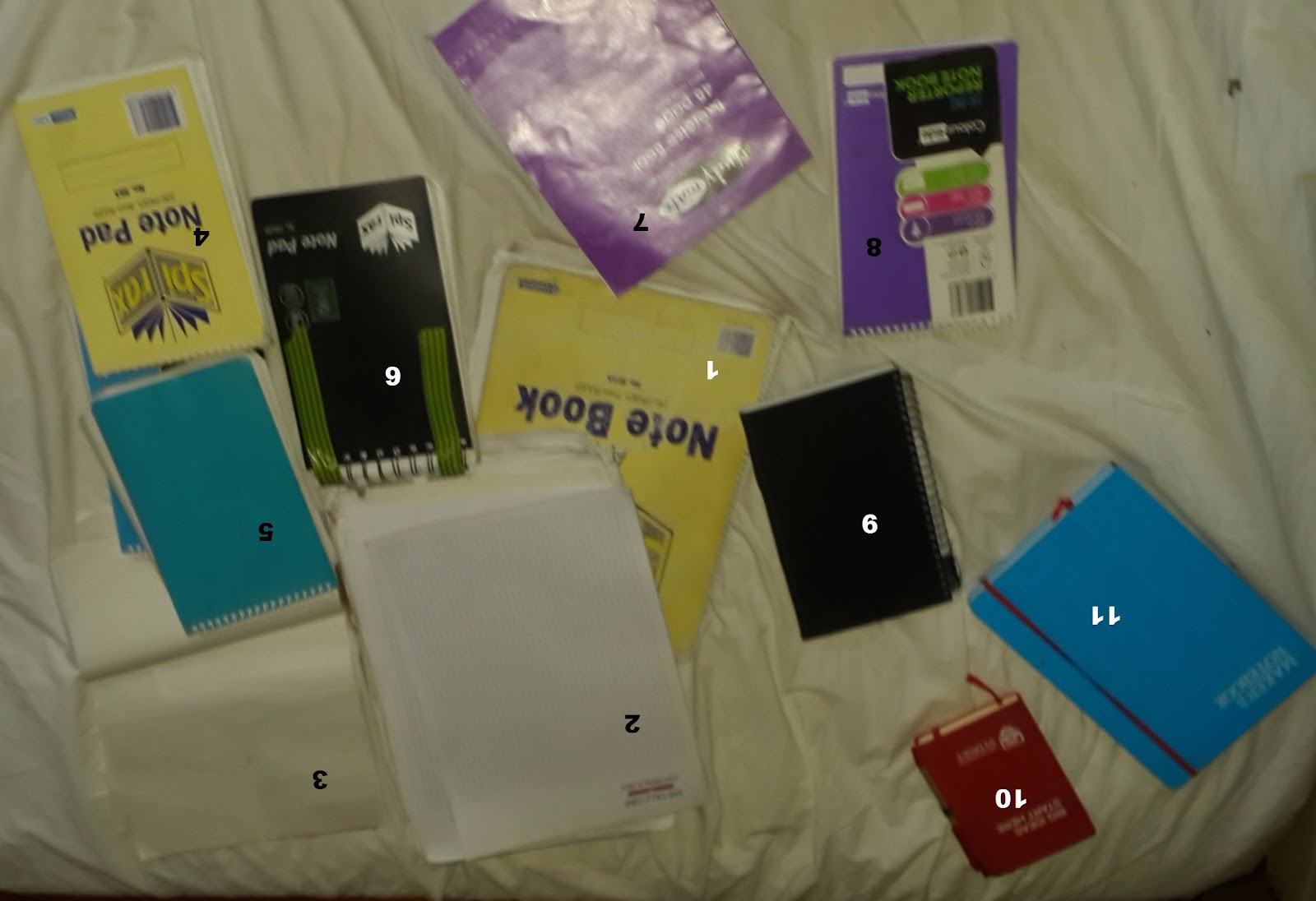
This picture includes some types of notebooks that I have tried.

  1. A4 lined paper cardboard front and back. Becomes difficult to carry because it was big. And hard to open it up and use it as well. side-bound is also something I didn’t like because I am left handed and it seemed to get in my way.

  2. bad photo but its a pad of grid-paper. I found a stack of these on the middle of the ground late at night as if they fell off a truck or something. I really liked them except for them being stuck together by essentially nothing and falling to pieces by the time I got to the bottom of the pad.

  3. lined note paper. I will never go back to a book that doesn’t hold together. The risk of losing paper is terrible. I don’t mind occasionally ripping out some paper but to lose a page when I didn’t want to; has never worked safely for me.

  4. Top spiral bound; 100 pages. This did not have enough pages; I bought it after a 200pager ran out of paper and I needed a quick replacement, well it was quick – I used it up in half the time the last book lasted.

  5. Top spiral bound 200 pages notepad, plastic cover; these are the type of book I currently use. 8 is my book that I am writing in right now. I used a few of these, I didn’t have a system for transition and made mistakes leaving the old book at home, and not carrying a new book when I needed it.

  6. 300 pages top spiral bound – as you can see by the tape – it started falling apart by the time I got to the end of it.  It was too long.

  7. small A5 notebook. I got these because they were 48c each, they never worked for me. I would bend them, forget them, leave them in the wrong places, and generally not have them around when I wanted them.

  8. I am about half way through my current book; the first page of my book says 23/7/15, today it is 1/9/15. Estimate a book every 2 months. Although it really depends on how you use it.

  9. a future book I will try, It holds a pen so I will probably find that useful.

  10. also a future one, I expect it to be too small to be useful for me.

  11. A gift from a more organised person than I. It is a moleskin grid-paper book and I plan to also try it soon.

    20160716_222902
    My current system

  12. 128 page A5 book, I use roughly one a month.  Taped to the front with masking tape is last month’s book, taped to the back is the current book.  As a book fills up I add a new book and take away an old book.  Sometimes I don’t have so much time to review a book so it will sit there for a few weeks extra.  That’s also okay.  I try to get to it sooner.  In my review I rewrite any unfinished to-do’s. This way I don’t have any books falling apart and I have enough paper.  I also never lose a book or forget to carry it.

The important take-aways from this is – try several, they might work in different ways and for different reasons. Has your life change substantially i.e. you don’t sit much at a desk any more? Is the book not working; maybe another type of book would work better.

I only write on the bottom of the flip-page, and occasionally scrawl diagrams on the other side of the page. But only when they relevant. This way I can always flip through easy, and not worry about the other side of the paper.

2. carry a notebook. Everywhere. Find a way to make it a habit. Don’t carry a bag? You could. Then you can carry your notepad everywhere with you in a bag. Consider a pocket-sized book as a solution to not wanting to carry a bag.

3. when you stop moving; turn the notebook to the correct page and write the date.

Writing the date is almost entirely useless. I really never care what the date is. I sometimes care that when I look back over the book I can see the timeline around which the events happened, but really – the date means nothing to me.

What writing the date helps to do:

  • make sure you have a writing implement
  • make sure it works
  • make sure you are on the right page
  • make sure you can see the pad
  • make sure you can write in this position
  • make you start a page
  • make you consider writing more things
  • make it look to others like you know what you are doing (signalling that you are a note-taker, is super important to help people get used to you as a note-taker and encourage that persona onto you)

This is the reason why I write the date; I can’t specify enough why I don’t care about what date it is, but why I do it anyway.

4. Other things I write:

  • Names of people I meet. Congratulations; you are one step closer to never forgetting the name of anyone ever. Also when you want to think; “When did I last see bob”, you can kinda look it up in a dumb – date-sorted list. (to be covered in my post about names – but its a lot easier to look it up 5 minutes later when you have it written down)
  • Where I am/What event I am at. (nice to know what you go to sometimes)
  • What time I got here or what time it started (if its a meeting)
  • What time it ended (or what time I stopped writing things)

It’s at this point that the rest of the things you write are kinda personal choices some of mine are:

  • Interesting thoughts I have had
  • Interesting quotes people say
  • Action points that I want to do if I can’t do them immediately.
  • Shopping lists
  • diagrams of what you are trying to say.
  • Graphs you see.
  • the general topic of conversation as it changes. (so far this is enough for me to remember the entire conversation and who was there and what they had to say about the matter)

Sexy.

That’s right. I said it. Its sexy. There are occasional discussion events near to where I live; that I go to with a notepad. Am I better than the average dude who shows up to chat? no. But everyone knows me. The guy who takes notes. And damn they know I know what I am talking about. And damn they all wish they were me. You know how glasses became a geek-culture signal? Well this is too. Like no other. Want to signal being a sharp human who knows what’s going down? Carry a notebook, and show it off to people.

The coordinators have said to me; “It makes me so happy to see someone taking notes, it really makes me feel like I am saying something useful”. The least I can do is take notes.

Other notes about notebooks

The number of brilliant people I know who carry a book of some kind will far outweighs the number of people who don’t. I don’t usually trust the common opinion; but sometimes you just gotta go with what’s right.

If it stops working; at least you tried it. If it works; you have evidence and can change the world in the future.

“I write in my phone”. (sounds a lot like, “I could write notes in my phone”) I hear this a lot.  Especially in person while I am writing notes. Indeed you do. Which is why I am the one with a notebook out and at the end of talking to you I will actually have notes and you will not. If you are genuinely the kind of person with notes in their phone I commend you for doing something with technology that I cannot seem to have sorted out; but if you are like me; and a lot of other people who could always say they could take notes in their phone; but never do; or never look at those notes… Its time to fix this.

a quote from a friend – “I realized in my mid twenties that I would look like a complete badass in a decade, if I could point people to a shelf of my notebooks.” And I love this too.

A friend has suggested that flashcards are his brain; and notepads are not.  I agree that flashcards have benefits. namely to do with organising things around, shuffling etc.  It really depends on what notes you are taking.  I quite like having a default chronology to things, but that might not work for you.

In our local Rationality Dojo’s we give away notebooks.  For the marginal costs of a book of paper; we are making people’s lives better.

The big take away

Get a notebook; make notes; add value to your life.


Meta:

This post took 3 hours to write over a week

Please add your experiences if you work differently surrounding note taking.

Original post: http://lesswrong.com/r/discussion/lw/mpz/making_notes_an_instrumental_rationality_process/

Posted in self-improvement | Tagged , , , , , , , , , | Leave a comment

General buying considerations?

The following is an incomplete list of suggestions for generic considerations that you might like to make when you go out to buy a thing. I have tried to put the list in order; being generic – certain things will be more or less important in different orders.


0. Do I need the thing? Am I just wanting it on a whim (you are allowed to do that, but at least try to not do that for many expensive things that don’t have resale value)?  If a month had gone by, would I still be wanting it?

  1. What is the thing? What functionality considerations do you need to make?  What does it need to do?  If you already had it – what would it be doing? Will it fit in your life?
  2. What is your expected use? Daily? Once-off? Occasional? (no more than 5 times in your predicted future?)
  3. What do I want it to do?  Does this thing do what I want it to do?  (It can be very easy to buy a thing that doesn’t quite suit the need because we get distracted between wanting a thing and getting a thing)

Consider your options that avoid buying it:

  1. Can I borrow one from a friend? Or a family member? (some things cannot be borrowed like a wristwatch – no sense borrowing one if it’s an item you wear every day – or other reasons to not borrow a thing)
  2. Can I get one second hand?
    Some items are perfectly fine second hand, i.e. books, whereas others are potentially less fine (i.e. cars) where more can go wrong with a second hand one.  The point of this inclusion was to encourage you to consider it when you previously would not have. for whichever reason.  Books second hand can also be occasionally out of date or damaged; and cars second hand can be excellent purchases.
  3. Is anyone I know also interested in having the thing, and would they be willing to split the cost with me in order to have it on a kind of timeshare, and can we agree on a deprecation schedule such that one of us buys out the other’s share in the future, if one of us is moving away or something?
  4. Renting/hiring the thing – as a one off. (works for most power tools, as well as storage space, a boat, all kinds of things…).  It is also an option to rent short term while you decide if the thing fits your life.  i.e. rent a jetski.  If you find you don’t use it enough to warrant a full purchase you only needed to invest a little bit of the final cost; and might be saving money to do so.
  5. Timeshare – businesses exist around sharing cars; boats; holiday houses and various other products.  You might be able to take advantage of these businesses.
  6. Can I apply for credit for the thing? Can I get the item on consignment?
  7. Could I earn money using the thing and return some costs? (Am I likely to do that based on my past experiences doing so with other purchases?)

Knowledge about the thing:

  1. Do any of your trusted friends have opinions or knowledge in the area?
  2. What do online reviews say?
  3. Is there a community of enthusiasts (i.e. Online – reddit, whirlpool, stackX, other) who have resources or who you can outsource the search to?
  4. Are there experts in the field – (i.e. buying houses), is it worth engaging an expert for this transaction?
  5. How much time do I want to spend on considering and shopping vs how much use will I get out of the thing? (for items under $20, try not to spend more than half an hour on it; or it’s almost better to randomly buy one available {depending on your local minimum wage})

Purchase considerations:

  • What is my budget?
  • Can I afford it? (see options that avoid buying it)
  • Price range of the things on the market?
  • Is it cheaper somewhere else in the world and posted to me?
  • Can I ask for a discount?
  • Can I combine postage with other items?
  • How long will the thing last?
  • How long do I need it for?
  • How quickly do I need it?
  • Do I want to be able to sell it when I’m done?
  • What’s the return policy of the various places selling it vs price vs shipping?
  • What is the shipping time?
  • Does it come with a warranty?  Does the warranty last long enough for my liking?
  • Are any laws, customs or taxes applicable to it; or its purchase, or resale?
  • What’s the difference between the best price and the worst price, and when do you wind up spending more time (in terms of the value of your time) than that difference trying to get the best price?
  • Does it have resale value?  Do some have better resale than others? (are you actually a person who re-sells things? – have you resold a thing before?)
  • Can I get it in a physical store?  Can I get it online?

General specifics:

  • Is the one I want a quality item?
  • Is the item disposable or not? Have you considered the merits of a similar but disposable one? (or a similar non-disposable one)
  • Does it have the correct colour? Or other embellishments?
  • Do I have storage space for it within my existing storage area?
  • Is it big? Can I get a smaller one?
  • Is it heavy? Can I get a more lightweight version?
  • What are its power options? AC, DC, battery, built-in battery, built-in solar, etc.
  • What is it made out of? Does it come in metal, plastic, wood, etc. what would I prefer?
  • Does it suit my existing possessions?
  • Will this one cost more to repair than the other similar ones?

Miscellaneous considerations:

  • Do I have a backup for if this one fails?
  • What are the consequences of a lower-quality thing breaking while I’m using it?
  • Can I pay for it from someone who is going to donate proceeds to charitable causes?
  • For any purchase under $50 (adjust for your life circumstances) it’s not so much worth running through this checklist; but for more expensive purchases – it’s likely that if you want to appreciate that you put in effort and came to a good conclusion, a process like this will be helpful.
  • Is the process of buying it give me pleasure? Or I will suffer in a long line for it?
  • What kind of signalling is the thing going to give me?  Do I want that?
  • Does the thing have an upkeep or maintenance cost?

Nearly all of the points listed here could be expanded to its own post.  These points apply to everyone to different extents.  “Considering borrowing” is advice that is priceless to one person, and useless to another person.  similarly; “budget” might be significant to one person because they don’t spend often but then spend whatever they like when they need to; but useless to another person because they live and breathe budget.

I plan to cover this in another post about making advice applicable to you.


meta: 3 hours write up.  3-5 reviewers, slack channel inspiring the post, and giving me a place to flesh out the thoughts.

This post is certainly open to improvements.  Please add your comments below.


Original post: http://lesswrong.com/r/discussion/lw/mv8/general_buying_considerations/

See also other repositories on Lesswrong:

Posted in life maintenance | Tagged , , , , , , , , , , , , , , , , , , , , , , , , , | Leave a comment

Lesswrong real time chat

This is a short post to say that I have started and am managing a Slack channel for lesswrong.

Slack has only an email-invite option which means that I need an email address for anyone who wants to join.  Send me an Email PM with your email address if you are interested in joining.

There is a web interface and a mobile app that is better than google hangouts.

If you are interested in joining; consider this one requirement:

  • You must be willing to be charitable in your conversations with your fellow lesswrongers.

To be clear; This means (including but not limited to);

  • Steelman not strawman of discussion
  • Respect of others
  • patience
So far every conversation we have had has been excellent, there have been no problems at all and everyone is striving towards better understanding of each other.  This policy does not come out of a recognition of a failure to be charitable; but as a standard to set when moving forward.  I have no reason to expect it will be broken but all the same; I feel it is valuable to have.

I would like this to have several goals and purposes (some of which were collaboratively developed with other lesswrongers in the chat, and if more come up in the future too that would be good)

  • an aim for productive conversations, to make progress on our lives.
  • a brains trust for life-advice in all kinds of areas where, “outsource this decision to others” is an effective strategy.
  • collaborative creation of further rationality content
  • a safe space for friendly conversation on the internet (a nice place to hang out)
  • A more coherent and stronger connected lesswrong
  • Development of better ideas and strategies in how to personally improve the world.

So far the chat has been operating by private invite from me for about two weeks as a trial.  Since this post was created we now have an ongoing conversation with exciting new ideas being produced all the time.  If nothing else – its fun to be in.  If something – we are generating a growing space for rationality and other ideas.  I have personally gained two very good friends already; that I now talk to every day.  (Which coincidentally slowed me down from posting this notice because I was too busy with other things and learning from new people)

I realise this type of medium is not for all.  But I am keen to make it work.

I also realise that when people PM email me their email addresses – other people will not see how many of you have already signed up.  So generally assume that there have been others who are already signed up and don’t hesitate to join.  If you are wondering if you have anything to contribute; that’s exactly the type of person we want to be inviting.  By doing that thought you classify yourself as the type of person to try harder.  We want you (and others) to talk with us.

Edit: Topics we now host;

  • AI
  • Art and media
  • Goals of lesswrong
  • Human Relationships
  • Math
  • parenting
  • philosophy
  • political talk
  • programming
  • projects
  • Rational_Hell
  • real life advice
  • Resources and links
  • science
  • travelling
  • and some admin channels; the “welcome”, “misc”, and “RSS” from the lw site.

Edit: a week’s review for the first week of august in 2015: http://lesswrong.com/lw/msa/open_thread_sep_21_sep_27_2015/crk1

Edit – first week of October: http://lesswrong.com/r/discussion/lw/mub/open_thread_oct_5_oct_11_2015/csr3

Edit – 3rd week in october 2015: http://lesswrong.com/r/discussion/lw/mwt/open_thread_oct_26_nov_01_2015/cuq5

Edit – 3rd week in november 2015 http://lesswrong.com/r/discussion/lw/mzz/open_thread_nov_23_nov_29_2015/cwyl


Original post – http://lesswrong.com/r/discussion/lw/mpq/lesswrong_real_time_chat/

Posted in lesswrong | Tagged , , , , , | 1 Comment